
Wednesday, March 19, 2014


Tuesday, March 18, 2014

Sunday, March 16, 2014
High Court sez: You must choose between your constitutional rights
NOW HOLD ON ONE SECOND HERE! There are no conditions on the Fourth Amendment in the
Bill of Rights, so the courts are simply justifying the unconstitutional
behavior of the government, and by so doing, delegitimize themselves.
The U.S. Supreme Court apparently has decided to let Americans choose between their Second and Fourth Amendment rights, leaving untouched a lower court decision that supported the use of a violent SWAT attack on a man’s home because authorities were concerned about the mere presence of a weapon.
The Rutherford Institute represented John Quinn, who was shot in the no-knock raid by officers because he thought his home was being invaded by criminals and reached for his weapon.
Attorneys with William Olson P.C. and the the United States Justice Foundation also submitted the friend-of-the-court brief on behalf of Quinn.
They were appalled that the reason the officers chose to conduct a violent no-knock raid was based on the presence of a firearm, as if the weapon “could somehow load itself, disengage its own safety, open the door, and begin to fire at the police.”
 Quinn was targeted by police because his son – who was suspected of
possessing drugs – lived in the same home. His son was absent, and
police records reveal officers knew that fact when they broke into
Quinn’s home in a no-knock, SWAT-team style forced entry.
Quinn was targeted by police because his son – who was suspected of
possessing drugs – lived in the same home. His son was absent, and
police records reveal officers knew that fact when they broke into
Quinn’s home in a no-knock, SWAT-team style forced entry.
Rutherford said the decision lets stand a lower court ruling that “essentially makes lawful gun ownership and possession grounds for police to evade the protections afforded by the Fourth Amendment and improperly penalizes and limits the Second Amendment right to bear arms.”
“Whatever the issue might be, whether it’s mass surveillance, no-knock raids, or the right to freely express one’s views about the government, we’ve moved into a new age in which the rights of the citizenry are being treated as a secondary concern by the White House, Congress, the courts, and their vast holding of employees, including law enforcement officials,’ said John W. Whitehead, president of the Rutherford Institute and author of “A Government of Wolves: The Emerging American Police State.”
“The disconnect, of course, is that the Constitution establishes a far different scenario in which government officials, including the police, are accountable to ‘we the people.’ For it to be otherwise, for government concerns to trump individual freedoms, with government officials routinely sidestepping the Constitution and reinterpreting the law to their own purposes, makes a mockery of everything this nation is supposed to stand for – self-government, justice, and the rule of law.”
The case began in August 2006 when police in Collin County, Texas, obtained a warrant for Quinn’s home. Lower courts rejected Quinn’s objection to the no-knock entry on the grounds that because police had information that guns were present at the residence, they were justified in making a forced and unannounced invasion.
Quinn’s advocates argued that the tradeoff – of Fourth Amendment rights for Second Amendment rights, was improper.
“Although police had obtained a search warrant for John Quinn’s home based on information that Quinn’s son might possess drugs, the warrant did not authorize police to enter the residence without knocking and announcing their entry. During the raid, Quinn was shot by police because he had reached for his lawfully owned firearm, thinking that his home was being invaded by criminals,” Rutherford explained.
The friend-of-the-court brief agreed.
“John Quinn lawfully kept firearms in his home for self-defense, exercising a freedom which this court has recognized to be a ‘core’ and ‘fundamental’ right protected by the 2nd Amendment. Yet based on the presence of firearms alone, the police conducted a no-knock raid, smashing down Quinn’s front door in the middle of the night, leading to his being shot,” the brief explained.
“The police knew that Quinn’s son, Brian, the target of the raid, was not at home, and they knew that Quinn was a law abiding man. Indeed, the state of Texas had certified him as such by licensing him to carry a concealed weapon. Yet the Texas court embraced the prosecution’s theory that the police were in such grave danger from a sleeping man and an inanimate object that they were permitted to dispense with 4th Amendment requirement to knock on the door and announce themselves.”
The attorneys argued: “At common law, a person was presumed a trespasser if he was present on the property of another without permission, as the police were in this case. Thus, the police needed to justify their presence in Quinn’s home. Although they had a warrant to search the home, they did not have any valid legal justification for using a battering ram to get through the door, making them nothing more than trespassers.”
The brief warned that if “police are now permitted to justify no-knock raids any time there is a firearm in a residence, no American home is safe from a terrifying, middle of the night, home invasion.”
The U.S. Supreme Court apparently has decided to let Americans choose between their Second and Fourth Amendment rights, leaving untouched a lower court decision that supported the use of a violent SWAT attack on a man’s home because authorities were concerned about the mere presence of a weapon.
The Rutherford Institute represented John Quinn, who was shot in the no-knock raid by officers because he thought his home was being invaded by criminals and reached for his weapon.
Attorneys with William Olson P.C. and the the United States Justice Foundation also submitted the friend-of-the-court brief on behalf of Quinn.
They were appalled that the reason the officers chose to conduct a violent no-knock raid was based on the presence of a firearm, as if the weapon “could somehow load itself, disengage its own safety, open the door, and begin to fire at the police.”
Rutherford said the decision lets stand a lower court ruling that “essentially makes lawful gun ownership and possession grounds for police to evade the protections afforded by the Fourth Amendment and improperly penalizes and limits the Second Amendment right to bear arms.”
“Whatever the issue might be, whether it’s mass surveillance, no-knock raids, or the right to freely express one’s views about the government, we’ve moved into a new age in which the rights of the citizenry are being treated as a secondary concern by the White House, Congress, the courts, and their vast holding of employees, including law enforcement officials,’ said John W. Whitehead, president of the Rutherford Institute and author of “A Government of Wolves: The Emerging American Police State.”
“The disconnect, of course, is that the Constitution establishes a far different scenario in which government officials, including the police, are accountable to ‘we the people.’ For it to be otherwise, for government concerns to trump individual freedoms, with government officials routinely sidestepping the Constitution and reinterpreting the law to their own purposes, makes a mockery of everything this nation is supposed to stand for – self-government, justice, and the rule of law.”
The case began in August 2006 when police in Collin County, Texas, obtained a warrant for Quinn’s home. Lower courts rejected Quinn’s objection to the no-knock entry on the grounds that because police had information that guns were present at the residence, they were justified in making a forced and unannounced invasion.
Quinn’s advocates argued that the tradeoff – of Fourth Amendment rights for Second Amendment rights, was improper.
“Although police had obtained a search warrant for John Quinn’s home based on information that Quinn’s son might possess drugs, the warrant did not authorize police to enter the residence without knocking and announcing their entry. During the raid, Quinn was shot by police because he had reached for his lawfully owned firearm, thinking that his home was being invaded by criminals,” Rutherford explained.
The friend-of-the-court brief agreed.
“John Quinn lawfully kept firearms in his home for self-defense, exercising a freedom which this court has recognized to be a ‘core’ and ‘fundamental’ right protected by the 2nd Amendment. Yet based on the presence of firearms alone, the police conducted a no-knock raid, smashing down Quinn’s front door in the middle of the night, leading to his being shot,” the brief explained.
“The police knew that Quinn’s son, Brian, the target of the raid, was not at home, and they knew that Quinn was a law abiding man. Indeed, the state of Texas had certified him as such by licensing him to carry a concealed weapon. Yet the Texas court embraced the prosecution’s theory that the police were in such grave danger from a sleeping man and an inanimate object that they were permitted to dispense with 4th Amendment requirement to knock on the door and announce themselves.”
The attorneys argued: “At common law, a person was presumed a trespasser if he was present on the property of another without permission, as the police were in this case. Thus, the police needed to justify their presence in Quinn’s home. Although they had a warrant to search the home, they did not have any valid legal justification for using a battering ram to get through the door, making them nothing more than trespassers.”
The brief warned that if “police are now permitted to justify no-knock raids any time there is a firearm in a residence, no American home is safe from a terrifying, middle of the night, home invasion.”
10 Healing Herbs To Grow in Your Survival Garden
Basil: People don’t usually think of basil as a healing herb
and yet traditionally, it is called the “king of herbs”. It is used
medicinally as a natural anti-inflammatory and is thought to have mild
antiseptic functions. Some healing uses are for flatulence, lack off
appetite, nausea and cuts and scrapes.
It is also superb on spaghetti and in pesto but then you already knew that. Basil is an annual plant so you will have to start anew each year.
German Chamomile: Chamomile is one of the most popular herbs in the Western world. Its flower heads are commonly used for infusions, teas and slaves. These in turn can be used to treat indigestion, anxiety and skin inflammations. As a tea, it serves as a mild sedative to help with sleep.
 Feverfew:
This perennial is a member of the sunflower family and has been used
for centuries in European folk medicine as a remedy for headaches,
arthritis, and fevers. The name feverfew comes from a Latin word
meaning “fever reducer.”
Feverfew:
This perennial is a member of the sunflower family and has been used
for centuries in European folk medicine as a remedy for headaches,
arthritis, and fevers. The name feverfew comes from a Latin word
meaning “fever reducer.”
Its many uses include easing headache pains – especially migraines. This is done by chewing on the leaves. A tea made from the leaves and flowers is said to relieve the symptoms of arthritis.
Lemon Balm: Lemon balm is a member of the mint family. Considered a calming herb, it has been used as far back as the Middle Ages to reduce stress and anxiety, promote sleep, improve appetite, and ease pain and discomfort from indigestion. Even before the Middle Ages, lemon balm was steeped in wine to lift the spirits, help heal wounds, and treat venomous insect bites and stings.
As with many other herbs in your healing garden, lemon balm promotes relaxation and a sense of calm.
Parsley: While not one of my favorites, there is nothing like a sprig of parsley to take away bad breath. It is no wonder that this biennial (meaning it lives for two years) is used to decorate and garnish plates in the fanciest of restaurants.
When brewed as a tea, parsley can help supplement iron in a person’s diet, particularly for those who are anemic. Drinking parsley tea also boosts energy and overall circulation of the body, and helps battle fatigue from lack of iron. Other uses? Parsley tea fights gas and flatulence in the belly, kidney infections, and bladder infections. It can also be an effective diuretic.
Sage: Did you know that the genus name for sage is “salvia” which means “to heal”? In the first century C.E. Greek physician Dioscorides reported that sage stopped bleeding of wounds and cleaned ulcers and sores. He also recommended sage juice in warm water for hoarseness and cough. In modern times, a sage tea is used to sooth mouth, throat and gum inflammations. This is because sage has excellent antibacterial and astringent properties.
Thyme: Back during medieval times, thyme was given to knights before going in to battle. The purpose was to infuse this manly man with vigor and courage.
These days, thyme used to relieve coughs, congestion, indigestion and gas. This perennial is rich in thymol, a strong antiseptic, making thyme highly desirable in the treatment of wounds and even fungus infections. Thyme is a perennial that does well, even in cooler, Pacific Northwest climates.
Rosemary: Long ago, rosemary was known as ‘the herb of remembrance.’ Even today, in places like Australia and New Zealand, it is used as a symbol of remembrance since it is known to help sharpen mental clarity and stimulate brain function. You might recall that many statues of the ancient Greeks and Romans show men wearing sprigs of rosemary on their heads – signifying mental acuity.
The needles of the delightfully fragrant rosemary plant can be used in a tea to treat digestive problems. The same tea can also be used as an expectorant and as a relaxing beverage that is helpful for headaches. Other healing uses include improving memory, relieving muscle pain and spasms, stimulating hair growth, and supporting the circulatory and nervous systems.
Peppermint: Peppermint has a long tradition of medicinal use. Archaeological evidence places its use far back as ten thousand years ago. It is commonly used to soothe or treat symptoms such as nausea, vomiting, abdominal pain, indigestion, irritable bowel, and bloating and more.
The leaves and stems contain menthol which in addition to use medicinally, is used as a flavoring in food, and a fragrance in cosmetics. The plant is prolific, growing well in moist, shaded areas as well as in sunnier locations. The roots emit runners that can quickly overtake the garden so most gardeners prefer to plant peppermint in pots.
The easiest way to acquire a peppermint plant? Find a friend or neighbor that is growing peppermint to break off a stem. Place it is a glass of water and in a very short period of times, roots will form an you will have your own peppermint start.
Lavender: I saved my personal favorite for last. Of course it helps that I have an abundant amount of fragrant lavender in my yard.
A tea made from lavender has many uses with one of the foremost being it’s ability to have a calming effect on a person’s mind and body. To that end, lavender can promote a sense of well-being and alleviate stress. It is also useful for dealing with various gastrointestinal issues such as upset stomachs and flatulence.
Because it is a strong antiseptic, lavender tea, when applied topically, can help heal cuts, wounds and sores. It can also be used to mitigate bad breath.
How Do I Get Started?
With so many to herbs to choose from, where do you start? A lot will depend on the amount of space you have, the climate, and the availability of seeds, starts, or cuttings. My recommendation is that you start with three or four herbs that appeal to you from a healing perspective. Many can be grown in pots on a porch or deck so if space is a problem, you can start modestly.
How to Make an Herbal Tea
The process of making a pot of herbal tea is in itself healing. Perhaps that has something to do with the proactive effort involved in doing something positive for one’s own self and well-being. And luckily, brewing an herbal tea is easy.
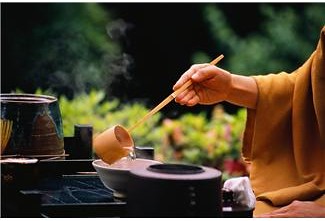
To make an herbal tea, first bring some cool water to a boil. While waiting for the water to boil, fetch a non-mental container that will be used to brew the tea. A quart mason jar works nicely for this purpose. You do not want to use a metal container since the metal may interfere with the purity and taste of the tea.
Add 2 tablespoons of fresh (or 1 tablespoon of dried herb or crushed seed) to the empty pot or jar for each cup of water. Then, and this is the important part, add an extra 2 tablespoons of fresh (or 1 tablespoon of dried) herbs “for the pot.” So, for example, if you are making 2 cups of hot tea, you would use 6 tablespoons of fresh herbs or 3 tablespoons of dried herbs.
Pour the boiling water over the herbs and let them steep, covered, for about 5 minutes give or take. There is no exact time since everyone’s strength preference is difference. When ready, strain the herbs and pour the tea into a cup. At this point you may want to garnish your heavenly – and healing – cup of tea with honey, citrus fruits or addition herb sprigs.
For iced tea, increase the quantity of herbs in the basic recipe by 1 1/2 to allow for dilution from the melting ice.
The Final Word
In reading about these herbs, you may have noticed that many are reputed to have the same or similar healing qualities. Do they work? I can personally vouch for Rosemary and Lavender which I have used as both a tea and as an essential oil.
One thing that is true is that with a little time and for a nominal cost, you can grow the makings for healing teas, infusions and balms in your own garden. Add a dose of sun and some rich potting soil and you will be set to go. Just keep in mind that while perennial plants will flourish over the winter and will be there for you the following spring, annual plants must be reseeded or restarted every year.
If you would like to learn more about the healing properties of various herbs, the University of Maryland Medical Center has an excellent web site with a lot of useful information about herbs and other alternative medicine topics. Click on “herbs” then scroll down to the particular herb you would like to learn about.
Also note this disclaimer: I am not a health care practitioner and anything I write should not be construed as medical advice. If you have a serious condition, consult a physician or nurse practitioner if one is available. And if not, consult a reliable reference such as my favorite, The Survival Medicine Handbook: A Guide for When Help is Not on the Way.
It is also superb on spaghetti and in pesto but then you already knew that. Basil is an annual plant so you will have to start anew each year.
German Chamomile: Chamomile is one of the most popular herbs in the Western world. Its flower heads are commonly used for infusions, teas and slaves. These in turn can be used to treat indigestion, anxiety and skin inflammations. As a tea, it serves as a mild sedative to help with sleep.
Feverfew:
This perennial is a member of the sunflower family and has been used
for centuries in European folk medicine as a remedy for headaches,
arthritis, and fevers. The name feverfew comes from a Latin word
meaning “fever reducer.”Its many uses include easing headache pains – especially migraines. This is done by chewing on the leaves. A tea made from the leaves and flowers is said to relieve the symptoms of arthritis.
Lemon Balm: Lemon balm is a member of the mint family. Considered a calming herb, it has been used as far back as the Middle Ages to reduce stress and anxiety, promote sleep, improve appetite, and ease pain and discomfort from indigestion. Even before the Middle Ages, lemon balm was steeped in wine to lift the spirits, help heal wounds, and treat venomous insect bites and stings.
As with many other herbs in your healing garden, lemon balm promotes relaxation and a sense of calm.
Parsley: While not one of my favorites, there is nothing like a sprig of parsley to take away bad breath. It is no wonder that this biennial (meaning it lives for two years) is used to decorate and garnish plates in the fanciest of restaurants.
When brewed as a tea, parsley can help supplement iron in a person’s diet, particularly for those who are anemic. Drinking parsley tea also boosts energy and overall circulation of the body, and helps battle fatigue from lack of iron. Other uses? Parsley tea fights gas and flatulence in the belly, kidney infections, and bladder infections. It can also be an effective diuretic.
Sage: Did you know that the genus name for sage is “salvia” which means “to heal”? In the first century C.E. Greek physician Dioscorides reported that sage stopped bleeding of wounds and cleaned ulcers and sores. He also recommended sage juice in warm water for hoarseness and cough. In modern times, a sage tea is used to sooth mouth, throat and gum inflammations. This is because sage has excellent antibacterial and astringent properties.
Thyme: Back during medieval times, thyme was given to knights before going in to battle. The purpose was to infuse this manly man with vigor and courage.
These days, thyme used to relieve coughs, congestion, indigestion and gas. This perennial is rich in thymol, a strong antiseptic, making thyme highly desirable in the treatment of wounds and even fungus infections. Thyme is a perennial that does well, even in cooler, Pacific Northwest climates.
Rosemary: Long ago, rosemary was known as ‘the herb of remembrance.’ Even today, in places like Australia and New Zealand, it is used as a symbol of remembrance since it is known to help sharpen mental clarity and stimulate brain function. You might recall that many statues of the ancient Greeks and Romans show men wearing sprigs of rosemary on their heads – signifying mental acuity.
The needles of the delightfully fragrant rosemary plant can be used in a tea to treat digestive problems. The same tea can also be used as an expectorant and as a relaxing beverage that is helpful for headaches. Other healing uses include improving memory, relieving muscle pain and spasms, stimulating hair growth, and supporting the circulatory and nervous systems.
Peppermint: Peppermint has a long tradition of medicinal use. Archaeological evidence places its use far back as ten thousand years ago. It is commonly used to soothe or treat symptoms such as nausea, vomiting, abdominal pain, indigestion, irritable bowel, and bloating and more.
The leaves and stems contain menthol which in addition to use medicinally, is used as a flavoring in food, and a fragrance in cosmetics. The plant is prolific, growing well in moist, shaded areas as well as in sunnier locations. The roots emit runners that can quickly overtake the garden so most gardeners prefer to plant peppermint in pots.
The easiest way to acquire a peppermint plant? Find a friend or neighbor that is growing peppermint to break off a stem. Place it is a glass of water and in a very short period of times, roots will form an you will have your own peppermint start.
Lavender: I saved my personal favorite for last. Of course it helps that I have an abundant amount of fragrant lavender in my yard.
A tea made from lavender has many uses with one of the foremost being it’s ability to have a calming effect on a person’s mind and body. To that end, lavender can promote a sense of well-being and alleviate stress. It is also useful for dealing with various gastrointestinal issues such as upset stomachs and flatulence.
Because it is a strong antiseptic, lavender tea, when applied topically, can help heal cuts, wounds and sores. It can also be used to mitigate bad breath.
How Do I Get Started?
With so many to herbs to choose from, where do you start? A lot will depend on the amount of space you have, the climate, and the availability of seeds, starts, or cuttings. My recommendation is that you start with three or four herbs that appeal to you from a healing perspective. Many can be grown in pots on a porch or deck so if space is a problem, you can start modestly.
How to Make an Herbal Tea
The process of making a pot of herbal tea is in itself healing. Perhaps that has something to do with the proactive effort involved in doing something positive for one’s own self and well-being. And luckily, brewing an herbal tea is easy.
To make an herbal tea, first bring some cool water to a boil. While waiting for the water to boil, fetch a non-mental container that will be used to brew the tea. A quart mason jar works nicely for this purpose. You do not want to use a metal container since the metal may interfere with the purity and taste of the tea.
Add 2 tablespoons of fresh (or 1 tablespoon of dried herb or crushed seed) to the empty pot or jar for each cup of water. Then, and this is the important part, add an extra 2 tablespoons of fresh (or 1 tablespoon of dried) herbs “for the pot.” So, for example, if you are making 2 cups of hot tea, you would use 6 tablespoons of fresh herbs or 3 tablespoons of dried herbs.
Pour the boiling water over the herbs and let them steep, covered, for about 5 minutes give or take. There is no exact time since everyone’s strength preference is difference. When ready, strain the herbs and pour the tea into a cup. At this point you may want to garnish your heavenly – and healing – cup of tea with honey, citrus fruits or addition herb sprigs.
For iced tea, increase the quantity of herbs in the basic recipe by 1 1/2 to allow for dilution from the melting ice.
The Final Word
In reading about these herbs, you may have noticed that many are reputed to have the same or similar healing qualities. Do they work? I can personally vouch for Rosemary and Lavender which I have used as both a tea and as an essential oil.
One thing that is true is that with a little time and for a nominal cost, you can grow the makings for healing teas, infusions and balms in your own garden. Add a dose of sun and some rich potting soil and you will be set to go. Just keep in mind that while perennial plants will flourish over the winter and will be there for you the following spring, annual plants must be reseeded or restarted every year.
If you would like to learn more about the healing properties of various herbs, the University of Maryland Medical Center has an excellent web site with a lot of useful information about herbs and other alternative medicine topics. Click on “herbs” then scroll down to the particular herb you would like to learn about.
Also note this disclaimer: I am not a health care practitioner and anything I write should not be construed as medical advice. If you have a serious condition, consult a physician or nurse practitioner if one is available. And if not, consult a reliable reference such as my favorite, The Survival Medicine Handbook: A Guide for When Help is Not on the Way.
Tuesday, March 11, 2014
Court rules our dependency on corporations isn’t choice - Its law
It’s no secret that an opposition to
sustainable living exists. Earlier this year, Texas state brought
several SWAT teams to a sustainable community and threatened to shut it
down. Each one of the community members were initially handcuffed at
gunpoint. It was called “The Garden of Eden Community,” and was totally
self sustainable. You can read more about that here.

This time, it’s Robin Speronis that’s
come under fire. She lives off the grid in Florida, completely
independent of the city’s water and electric system. A few weeks ago,
officials ruled her off-grid home illegal. Officials cited the International Property Maintenance Code,
which mandates that homes be connected to an electricity grid and a
running water source. That’s just like saying our dependency on
corporations isn’t even a choice. The battle to live without most
utilities has been ongoing for Robin, the self-sufficient woman has
lived for more than a year and a half using solar energy, a propane
camping stove and rain water.
In the end, she was found not guilty of
not having a proper sewer or electrical system; but was guilty of not
being hooked up to an approved water supply.
So what exactly is off grid living?
“It means living independently,
mainly living independently of the utility companies. Providing your own
power. It does not mean living in the stone age, it’s not about bush
craft. It’s about generating your own power, your own water, dealing
with your own waste. Probably as part of a community, not living on your
own like a hermit. It’s also about being more self-reliant and being
less dependent on the system. Perhaps realizing that the system isn’t really protecting us anymore and we have to look after ourselves.” - George Noory
Our potential as a human race is quite
extraordinary, we just don’t realize it. Sustainable living is not about
giving up a certain lifestyle, can still have all the modern amenities,
design and beyond. Living off the grid wouldn’t be a problem, we have
technologies that can generate over-unity power, we have technologies
that can provide unlimited amounts of clean energy. I’m talking about free energy,
which goes far beyond solar energy. We can have neighborhoods exactly
like we do today, even better. They would be totally green, off the grid
and self-sufficient.
The only problem with off the grid
living is that corporations lose their ability to control others. With a
completely self-sustaining life style, no body would ever have to work.
What would happen then? Think about that for a moment. We would be free
to expand and create, to discover our full potential as a race and move
forward into the world of exploration and discovery, all the while
living in harmony with nature, not against it.
We’ve accepted the monetary system, and
deem it necessary for the proper function of society. Money doesn’t ever
have to come in the way of necessity, we’ve just been made to believe
that it does. It’s time for the human race to move past the concepts of
competition and greed into one that benefits the whole.
“One of the saddest lessons of
history is this: If we’ve been bamboozled long enough, we tend to reject
any evidence of the bamboozle. We’re no longer interested in finding
out the truth. The bamboozled has captured us. It’s simply too painful
to acknowledge, even to ourselves, that we’ve been taken. Once you give a
charlatan power over you, you almost never get it back.” - Carl Sagan
The human race does not need to be
dependent on these corporations. While we continue to feed this
dependency, the planet continues to suffer. In order to move forward, we
must start cooperating with each other, and realize just how much
potential we have to create something magical and amazing. Bottom line,
anybody who has the desire to live off-grid should not be hassled for
it, it should be a free choice.
Sources:
Monday, March 10, 2014
Game Changer: It Will Be Shocking for the Average American: “Your Cost of Living Will Quadruple”
By Mac Slavo
SHTF plan.com
It’s no secret that the U.S. government is in serious fiscal trouble. So much so that our Treasury Secretary recently noted that should the debt ceiling fail to be increased, the fall-out would be “catastrophic” and last for generations.
Given that sobering report, consider that everything in America, from food to fuel, is subsidized in one way or another. Those subsidies are being paid with ever-increasing debt. It is inevitable that at some point the world’s reserve currency, the US dollar, will be wiped out. The trigger for such an event is irrelevant. What is relevant, is how average Americans will be affected when that day comes.
 In recent months working Americans have seen their health care costs
triple. But this is just the beginning. When America’s debt problems
come to a head the subsidies will be removed, and that will lead to cost
of living increases that will leave those who never saw it coming in a
state of confusion and bewilderment with no way out.
In recent months working Americans have seen their health care costs
triple. But this is just the beginning. When America’s debt problems
come to a head the subsidies will be removed, and that will lead to cost
of living increases that will leave those who never saw it coming in a
state of confusion and bewilderment with no way out.
Marin Katusa of Casey Research, who has met with business and political leaders in over one hundred countries and is one of the most successful contrarian investment analysts out there, has some thoughts on the matter.
(
For those with retirement investments like 401k’s, IRA’s or cash, Marin suggests you look to healthy gold companies as insurance. Back in the Great Depression of the 1930′s, as stocks crashed and then stagnated, those with investments in gold mining companies were able to not only preserve wealth, but grow it.
Those who prefer to keep their assets in physical holdings should look to gold and silver bullion, as well as those items that will become difficult to obtain when prices sky rocket. These core physical assets might mean long-term food stores, land with productive capacity, and personal energy production facilities that may include wind, solar or hydro.
If there is one trend that has taken hold over the last decade it’s continued price rises for the basic necessities of modern life. Given that we are now in more debt as a nation and individuals than ever before, it’s not hard to see where this is headed.
If you need a mainstream forecast to confirm what’s going to happen, then we point you to the words of President Barack Obama, who several years ago stated unequivocally that, “electricity rates will necessarily skyrocket.” He should know, because his policies are a significant contribution to what’s going to happen in the very near future.
Look out below.
SHTF plan.com
It’s no secret that the U.S. government is in serious fiscal trouble. So much so that our Treasury Secretary recently noted that should the debt ceiling fail to be increased, the fall-out would be “catastrophic” and last for generations.
Given that sobering report, consider that everything in America, from food to fuel, is subsidized in one way or another. Those subsidies are being paid with ever-increasing debt. It is inevitable that at some point the world’s reserve currency, the US dollar, will be wiped out. The trigger for such an event is irrelevant. What is relevant, is how average Americans will be affected when that day comes.
Marin Katusa of Casey Research, who has met with business and political leaders in over one hundred countries and is one of the most successful contrarian investment analysts out there, has some thoughts on the matter.
It will be shocking for the average American… if the petro dollar dies and the U.S. loses its reserve currency status in the world there will be no middle class.In the following must-watch interview with the Sound Money Campaign, Marin outlines the reasons for why our cost of living is going through the roof, the effects of geo-politics on our future, and ways to insulate yourself from what’s coming.
The middle class and the low class… wow… what a game changer. Your cost of living will quadruple.
(
Imagine this… take a country like Croatia… the average worker with a university degree makes about 1200 Euros a month. He spends a third of that, after tax, on keeping his house warm and filling up his gas tank to get to work and get back from work.As Marin notes, the assets you hold should be such that they maintain or increase their value as the Petrol dollar crashes and America’s debt bubble bursts.
In North America, we don’t make $1200 a month, and we don’t spend a third of our paycheck on keeping our house warm and driving to work… so, the cost of living… food will triple… heat, electricity, everything subsidized by the government will triple overnight… and it will only get worse even if you can get the services.
For the average citizen, they should be thinking, ‘I should store some gold here and there as insurance for all of this.’
Now, I don’t know when it will happen. But it will happen, because it’s happened to all currencies.
I don’t think the people of Rome thought that Rome would ever fall as an empire… but it did.
So, you have to be prepared and protect your family. That’s why you want leverage to things that have major upside when the dollar does collapse. And the best insurance for that is gold.
For those with retirement investments like 401k’s, IRA’s or cash, Marin suggests you look to healthy gold companies as insurance. Back in the Great Depression of the 1930′s, as stocks crashed and then stagnated, those with investments in gold mining companies were able to not only preserve wealth, but grow it.
Those who prefer to keep their assets in physical holdings should look to gold and silver bullion, as well as those items that will become difficult to obtain when prices sky rocket. These core physical assets might mean long-term food stores, land with productive capacity, and personal energy production facilities that may include wind, solar or hydro.
If there is one trend that has taken hold over the last decade it’s continued price rises for the basic necessities of modern life. Given that we are now in more debt as a nation and individuals than ever before, it’s not hard to see where this is headed.
If you need a mainstream forecast to confirm what’s going to happen, then we point you to the words of President Barack Obama, who several years ago stated unequivocally that, “electricity rates will necessarily skyrocket.” He should know, because his policies are a significant contribution to what’s going to happen in the very near future.
Look out below.
Please Spread The Word And Share This Post
20 facts about the great U.S. retail apocalypse that will blow your mind

If the U.S. economy is getting better, then why are major retail chains closing thousands of stores?
By Michael Snyder | The Economic Collapse Blog
If we truly are in an “economic recovery”, then why do sales figures continue to go down for large retailers all over the country? Without a doubt, the rise of Internet retailing giants such as Amazon.com have had a huge impact. Today, there are millions of Americans that actually prefer to shop online. Personally, when I published my novel I made it solely available on Amazon. But Internet shopping alone does not account for the great retail apocalypse that we are witnessing. In fact, some retail experts estimate that the Internet has accounted for only about 20 percent of the decline that we are seeing. Most of the rest of it can be accounted for by the slow, steady death of the middle class U.S. consumer. Median household income has declined for five years in a row, but all of our bills just keep going up. That means that the amount of disposable income that average Americans have continues to shrink, and that is really bad news for retailers.And sadly, this is just the beginning. Retail experts are projecting that the pace of store closings will actually accelerate over the course of the next decade.
So as you read this list below, please take note that things will soon get even worse.
The following are 20 facts about the great U.S. retail apocalypse that will blow your mind…
#1 As you read this article, approximately a billion square feet of retail space is sitting vacant in the United States.
#2 Last week, Radio Shack announced that it was going to close more than a thousand stores.
#3 Last week, Staples announced that it was going to close 225 stores.
#4 Same-store sales at Office Depot have declined for 13 quarters in a row.
#5 J.C. Penney has been dying for years, and it recently announced plans to close 33 more stores.
#6 J.C. Penney lost 586 million dollars during the second quarter of 2013 alone.
#7 Sears has closed about 300 stores since 2010, and CNN is reporting that Sears is “expected to shutter another 500 Sears and Kmart locations soon”.
#8 Overall, sales numbers have declined at Sears for 27 quarters in a row.
#9 Target has announced that it is going to eliminate 475 jobs and not fill 700 positions that are currently empty.
#10 It is being projected that Aéropostale will close about 175 stores over the next couple of years.
#11 Macy’s has announced that it is going to be closing five stores and eliminating 2,500 jobs.
#12 The Children’s Place has announced that it will be closing down125 of its “weakest” stores by 2016.
#13 Best Buy recently shut down about 50 stores up in Canada.
#14 Video rental giant Blockbuster has completely shut down all of their stores.
#15 It is being projected that sales at U.S. supermarkets will declineby 1.7 percent this year even as the overall population continues to grow.
#16 McDonald’s has reported that sales at established U.S. locationswere down 3.3 percent in January.
#17 A home appliance chain known as “American TV” in the Midwest is going to be shutting down all 11 stores.
#18 Even Wal-Mart is struggling right now. Just check out what one very prominent Wal-Mart executive recently admitted…
David Cheesewright, CEO of Walmart International was speaking at the same presentation, and he pointed out that Walmart would try to protect its market share in the US – where the company had just issued an earnings warning. But most of the growth would have to come from its units outside the US. I mean, via these share buybacks?#19 In a recent CNBC article entitled “Time to close Wal-Mart stores? Analysts think so“, it was recommended that Wal-Mart should close approximately 100 “underperforming” supercenters in rural locations across America.
Alas, outside the US too, economies were limping along at best, and consumers were struggling and the operating environment was tough. “We’re seeing economies under stress pretty much everywhere we operate,” Cheesewright admitted.
#20 Retail consultant Howard Davidowitz is projecting that up to halfof all shopping malls in America may shut down within the next 15 to 20 years…
Within 15 to 20 years, retail consultant Howard Davidowitz expects as many as half of America’s shopping malls to fail. He predicts that only upscale shopping centers with anchors like Saks Fifth Avenue and Neiman Marcus will survive.So is there any hope that things will turn around?
Well, if the U.S. economy started producing large numbers of good paying middle class jobs there would definitely be cause for optimism.
Unfortunately, that is just not happening.
On Friday, we were told that the U.S. economy added 175,000 jobs during the month of February.
That sounds pretty good until you realize that it takes almost that many jobs each month just to keep up with population growth.
And according to CNS News, the number of unemployed Americans actually grew faster than the number of employed Americans in February…
The number of unemployed individuals 16 years and over increased by 223,000 in February, according to the Bureau of Labor Statistics (BLS).Meanwhile, the labor force participation rate continues to sit at a 35 year low, and a staggering 70 percent of all Americans not in the labor force are below the age of 55.
In February, there were 10,459,000 unemployed individuals age 16 and over, which was up 223,000 from January, when there were 10,236,000 unemployed individuals.
That is outrageous.
And things look particularly depressing when you look at the labor force participation rate for men by themselves.
In 1950, the labor force participation rate for men was sitting at about 87 percent. Today, it has dropped beneath 70 percent to a brand new all-time record low.
The truth is that there simply are not enough jobs for everyone anymore.
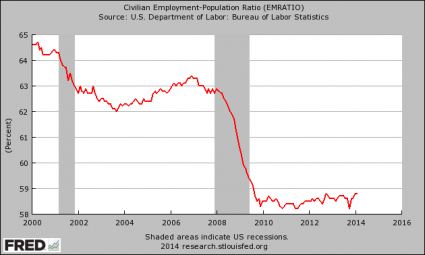
The chart posted below shows how the percentage of working age Americans that actually have a job has changed since the turn of the millennium. As you can see, the employment-population ratio declined precipitously during the last recession, and it has stayed below 59 percent since late 2009…
Since there are not enough jobs, what is happening is that more highly educated workers are taking the jobs that were once occupied by less educated workers and bumping them out of the labor force entirely. The following is an excerpt from a recent Bloomberg article…
Due to the fact that there are not enough middle class jobs to go around, the middle class has been steadily shrinking.Recent college graduates are ending up in more low-wage and part-time positions as it’s become harder to find education-level appropriate jobs, according to a January study by the Federal Reserve Bank of New York.The share of Americans ages 22 to 27 with at least a bachelor’s degree in jobs that don’t require that level of education was 44 percent in 2012, up from 34 percent in 2001, the study found.
In 2008, 53 percent of all Americans considered themselves to be “middle class”. Today, only 44 percent of all Americans consider themselves to be “middle class”.
That is a pretty significant shift in just six years, don’t you think?
For much more on this, please see my previous article entitled “28 Signs That The Middle Class Is Heading Toward Extinction“.
Despite what the politicians and the mainstream media are telling you, the truth is that something is fundamentally wrong with our economy.
On a gut level, most people realize this.
According to one recent survey, only 35 percent of all Americans say that they are better off financially than they were a year ago. And according to a recent NBC News/Wall Street Journal poll, only 28 percent of all Americans believe that this country is moving in the right direction.
The frightening thing is that this is about as good as things are going to get. The next great wave of the economic collapse is approaching, and when it strikes the plight of the middle class is going to get a whole lot worse.
(Photo: Wikimedia Commons)
This article originally appeared on The Economic Collapse Blog
Subscribe to:
Posts (Atom)