

Monday, March 10, 2014


Why is the TSA Ordering Dynamite?

13–Unimax dynamiteAccording to the company:
Solicitation Number: HSTS02-14-Q-NCP056
Agency: Department of Homeland Security
Office: Transportation Security Administration
Location: Headquarters TSA
The DHS Transportation Security Administration (TSA) requires the following items, Exact Match Only, to the following:
LI 001: UNIMAX extra gelatin NG- SIZE 1 1/2″ X 8″ tube shell DN231415008E, 1980, EA;
• UNIMAX is an excellent primer for Dynomix (ANFO), Dynomix-WR (WR ANFO) or other detonator sensitive packaged product and can be used as a secondary primer in hard seams or at the top of the explosive column.Now maybe I am just tired and not thinking straight but I can think of no good reason for the TSA to need dynamite.
• Minimum diameter is 25 mm (1 in).
• Minimum detonator is No. 8 strength.
• Storage at elevated temperatures and/or high humidity for 1 to 6 months can reduce the performance of Unimax depending on the diameter. Consult your Dyno Nobel representative for specific recommendations.
• Dynamites are susceptible to sympathetic detonation when applied in very wet conditions where boreholes are closely spaced and/or where geological conditions promote this effect. Consult your Dyno Nobel representative for recommendations where these conditions exist.
What about you?
Delivered by The Daily Sheeple
Quote De Jour
"What is masquerading as government is a crime syndicate
with a flag. The US Government is an instrument of organized crime,
alternatively described as the Octopus, the Washington Consensus, the
Shadow Government, Wall Street, the Round Table (Bilderbergs,
Trilaterals, Council on Foreign Relations, Royal Institute of
International Affairs), and the New World Order." -- Nikki Alexander

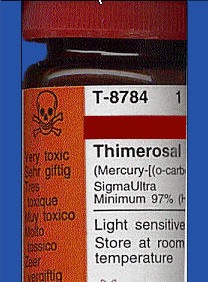
CDC forced to release documents showing they knew vaccine preservative causes autism
PhD Scientist and Biochemist Reveals Hidden CDC Documents Showing Thimerosal In Vaccines Increase Neurologic Disorders
 The
CDC has been shunning the correlations between thimerosal and
neurological disorders for a very long time. Although the FDA gave a two
year deadline to remove the mercury based preservative from vaccines
after the neurotoxin was banned in 1999, it still remains to this day in
60 percent of flu vaccines.
A vaccine industry watchdog has now obtained CDC documents that show
statistically significant risks of autism associated with the vaccine
preservative, something the CDC denies even when confronted with their
own data.
The
CDC has been shunning the correlations between thimerosal and
neurological disorders for a very long time. Although the FDA gave a two
year deadline to remove the mercury based preservative from vaccines
after the neurotoxin was banned in 1999, it still remains to this day in
60 percent of flu vaccines.
A vaccine industry watchdog has now obtained CDC documents that show
statistically significant risks of autism associated with the vaccine
preservative, something the CDC denies even when confronted with their
own data.For nearly ten years, Brian Hooker has been requesting documents that are kept under tight wraps by the Centers for Disease Control and Prevention (CDC). His more than 100 Freedom of Information Act (FOIA) requests have resulted in copious evidence that the vaccine preservative Thimerosal , which is still used in the flu shot that is administered to pregnant women and infants, can cause autism and other neurodevelopmental disorders.
Dr. Hooker, a PhD scientist, worked with two members of Congress to craft the letter to the CDC that recently resulted in his obtaining long-awaited data from the CDC, the significance of which is historic. According to Hooker, the data on over 400,000 infants born between 1991 and 1997, which was analyzed by CDC epidemiologist Thomas Verstraeten, MD, “proves unequivocally that in 2000, CDC officials were informed internally of the very high risk of autism, non-organic sleep disorder and speech disorder associated with Thimerosal exposure.” Factually, thimerosal is a mercury-containing compound that is a known human carcinogen, mutagen, teratogen and immune-system disruptor at levels below 1 part-per-million, and a compound to which some humans can have an anaphylactic shock reaction. It is also a recognized reproductive and fetal toxin with no established toxicologically safe level of exposure for humans.
In November, 1997, the U.S. Congress passed the Food and Drug Administration Modernization Act, requiring the study of mercury content in FDA-approved products. The review disclosed the hitherto-unrecognized levels of ethylmercury in vaccines.
In July 1999, public-health officials announced that thimerosal would be phased out of vaccines. The CDC, American Academy of Pediatrics, and FDA insisted that the measure was purely precautionary. They requested of all vaccine manufacturers to eliminate mercury from vaccines.
The requests were denied by vaccine manufacturers and continued every year thereafter.
The FDA does not require ingredients that comprise less than 1 percent of a product to be divulged on the label, so a lot more products may have thimerosal and consumers will never know .
Elevated Risk of Autism
When the results of the Verstraeten study were first reported outside the CDC in 2005, there was no evidence that anyone but Dr. Verstraeten within the CDC had known of the very high 7.6-fold elevated relative risk of autism from exposure to Thimerosal during infancy. But now, clear evidence exists. A newly-acquired abstract from 1999 titled, “Increased risk of developmental neurologic impairment after high exposure to Thimerosal containing vaccine in first month of life” required the approval of top CDC officials prior to its presentation at the Epidemic Intelligence Service (EIS) conference. Thimerosal, which is 50% mercury by weight, was used in most childhood vaccines and in the RhoGAM shot for pregnant women prior to the early 2000s.
The CDC maintains there is “no relationship between Thimerosal-containing vaccines and autism rates in children,” even though the data from the CDC’s own Vaccine Safety Datalink (VSD) database shows a very high risk. There are a number of public records to back this up, including this Congressional Record from May 1, 2003 . The CDC’s refusal to acknowledge thimerosal’s risks is exemplified by a leaked statement from Dr. Marie McCormick, chair of the CDC/NIH-sponsored Immunization Safety Review at IOM. Regarding vaccination, she said in 2001, “…we are not ever going to come down that it [autism] is a true side effect…” Also of note, the former director of the CDC, which purchases $4 billion worth of vaccines annually, is now president of Merck’s vaccine division.
Toxic Effects of Thimerosal No Longer Disputed by Scientific Study
Thimerosal-Derived Ethylmercury in vaccines is now well established as a mitochondrial toxin in human brain cells .
There are dozens of scientific inquiries and studies on the adverse effects of thimerosal, including gastrointestinal abnormalities and immune system irregularities.
Thimerosal, is metabolized (converted) into the toxic and “harmful” methylmercury. And then in turn, the harmful methylmercury is metabolized (converted) into the most harmful, long-term-toxic, “inorganic” mercury that is retained in bodily tissue.
“Inorganic” mercury is the end product of mercury metabolism. Methylmercury subject groups confirm that the metabolic pathway for mercury in the human and animal body consists in the reduction/conversion of the harmful methylmercury into a more harmful “inorganic” mercury which is tissue-bound, and long-term-toxic. Hence, both the originating substance (methylmercury) and its conversion/reduction, inorganic mercury are found.
Based on published findings by Dr. Paul King , the metabolic pathway for organic mercury involves the conversion of Ethylmercury (Thimerosal) into “methylmercury” and then the further reduction of “methylmercury” into inorganic mercury.
Congress Must Act
Dr. Hooker’s fervent hope for the future: “We must ensure that this
and other evidence of CDC malfeasance are presented to Congress and the
public as quickly as possible. Time is of the essence. Children’s
futures are at stake.” A divide within the autism community has led to
some activists demanding that compensation to those with vaccine-injury
claims be the top priority before Congress. Dr. Hooker maintains that
prevention, “protecting our most precious resource — children’s minds,”
must come first. “Our elected officials must be informed about
government corruption that keeps doctors and patients in the dark about
vaccine risks.”Referring to an organization that has seen its share of controversy this past year, Dr. Hooker remarked, “It is unfortunate that SafeMinds issued a press release on my information, is accepting credit for my work and has not supported a worldwide ban on Thimerosal.”
Brian Hooker, PhD, PE, has 15 years experience in the field of bioengineering and is an associate professor at Simpson University where he specializes in biology and chemistry. His over 50 science and engineering papers have been published in internationally recognized, peer-reviewed journals. Dr. Hooker has a son, aged 16, who developed normally but then regressed into autism after receiving Thimerosal-containing vaccines.
Sources:
prweb.com
preventdisease.com
ashotoftruth.org
Dave Mihalovic is a Naturopathic Doctor who specializes in vaccine research, cancer prevention and a natural approach to treatment.
Friday, March 7, 2014
Obamacare Surcharge Appearing on Restaurant Bills Across the Country
By Adan Salazar
The small business mandate doesn’t go into effect until 2015, but restaurants across the country are already passing the extra costs associated with having to offer healthcare to their employees on to consumers.
Double D’s Sourdough Pizza in Denver recently started adding a five percent charge to customer’s bills in order “to pay for half of the health care costs of all employees, both full- and part-time,” according to CBS Denver.
Double D’s owner Ted Dorr says he isn’t trying to make a political statement by subjecting patrons to the extra charge. He just wanted to be able to offer health care to his employees.
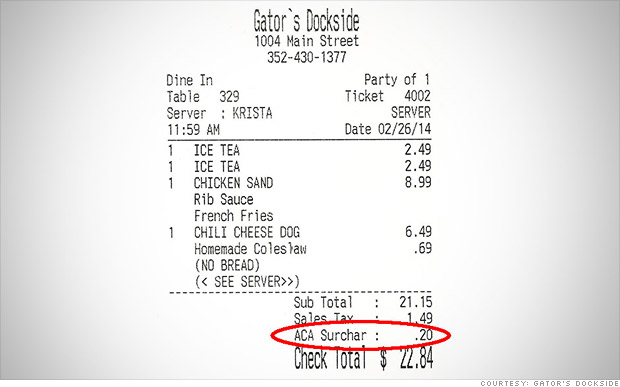
A restaurant chain in Florida also recently began adding a one percent surcharge to its customer’s bills.
According to CNN:
Gator’s statement echoes remarks made by Denny’s franchise owner John Metz in November 2012. Metz was in hot water after he proposed the “controversial” notion of charging customers a five percent surcharge to help share the healthcare burden.
“Although it may sound terrible that I’m doing this, it’s the only alternative. I’ve got to pass the cost on to the consumer,” Metz said at the time.
And the République restaurant in Los Angeles last month also began charging its customers an extra three percent to help stay afloat.
Under the guise of caring about people’s wellbeing, the Affordable Healthcare Act forces businesses with more than 50 employees to provide a healthcare option for their employees.
“I don’t think it should be shoved in people’s faces like this,” a frustrated Double D’s customer told CBS Denver.
Forced compliance is just one more way Obamacare is going to cost people jobs and in the process fleece the American people out of millions of dollars.
Zero Hedge notes, “The bottom line decision for businesses: fire your workers, or pass through the costs to other consumers. Many have done the former, or converted full-time workers to part-time status. Increasingly more are opting for the latter. How long until the popular outcry that this latest ‘freebie’ by the government was anything but.”
The small business mandate doesn’t go into effect until 2015, but restaurants across the country are already passing the extra costs associated with having to offer healthcare to their employees on to consumers.
Double D’s Sourdough Pizza in Denver recently started adding a five percent charge to customer’s bills in order “to pay for half of the health care costs of all employees, both full- and part-time,” according to CBS Denver.
Double D’s owner Ted Dorr says he isn’t trying to make a political statement by subjecting patrons to the extra charge. He just wanted to be able to offer health care to his employees.
A restaurant chain in Florida also recently began adding a one percent surcharge to its customer’s bills.
According to CNN:
The Gator Group’s full-time hourly employees won’t actually receive health insurance until December. But the company said it implemented the surcharge now because of the compliance costs it’s facing ahead of the Affordable Care Act’s employer mandate kicking in in 2015.A sign at the establishment noted, “The costs associated with ACA compliance could ultimately close our doors. Instead of raising prices on our products to generate the additional revenue needed to cover the costs of ACA compliance, certain Gator’s Dockside locations have implemented a 1% surcharge on all food and beverage purchases only.”
Gator’s statement echoes remarks made by Denny’s franchise owner John Metz in November 2012. Metz was in hot water after he proposed the “controversial” notion of charging customers a five percent surcharge to help share the healthcare burden.
“Although it may sound terrible that I’m doing this, it’s the only alternative. I’ve got to pass the cost on to the consumer,” Metz said at the time.
And the République restaurant in Los Angeles last month also began charging its customers an extra three percent to help stay afloat.
Under the guise of caring about people’s wellbeing, the Affordable Healthcare Act forces businesses with more than 50 employees to provide a healthcare option for their employees.
“I don’t think it should be shoved in people’s faces like this,” a frustrated Double D’s customer told CBS Denver.
Forced compliance is just one more way Obamacare is going to cost people jobs and in the process fleece the American people out of millions of dollars.
Zero Hedge notes, “The bottom line decision for businesses: fire your workers, or pass through the costs to other consumers. Many have done the former, or converted full-time workers to part-time status. Increasingly more are opting for the latter. How long until the popular outcry that this latest ‘freebie’ by the government was anything but.”
Monday, March 3, 2014
FDA advisory panel voted 11 – 2 AGAINST approving drug - FDA approves it anyway!
A new painkiller set to hit the market in March is coming under heavy
fire from doctors and lawmakers warning of its powerful ability to
kill.
Although the opiate Zohydro was ultimately approved by the US Food and Drug administration, that endorsement went against the recommendation given by the agency’s own advisory panel. The panel voted 11 – 2 against approving the drug, but the FDA argued its availability is necessary to help patients unfazed by current medication.
 The new drug hasn’t become available yet, but a group of more
than 40 doctors is hoping to preempt its release by urging the
FDA to reconsider its decision. According to the letter penned by
the doctors, Zohydro is five to 10 times stronger than its
nearest equivalent, Vicodin, and has the potential to cause a
severe rise in overdose deaths.
The new drug hasn’t become available yet, but a group of more
than 40 doctors is hoping to preempt its release by urging the
FDA to reconsider its decision. According to the letter penned by
the doctors, Zohydro is five to 10 times stronger than its
nearest equivalent, Vicodin, and has the potential to cause a
severe rise in overdose deaths.
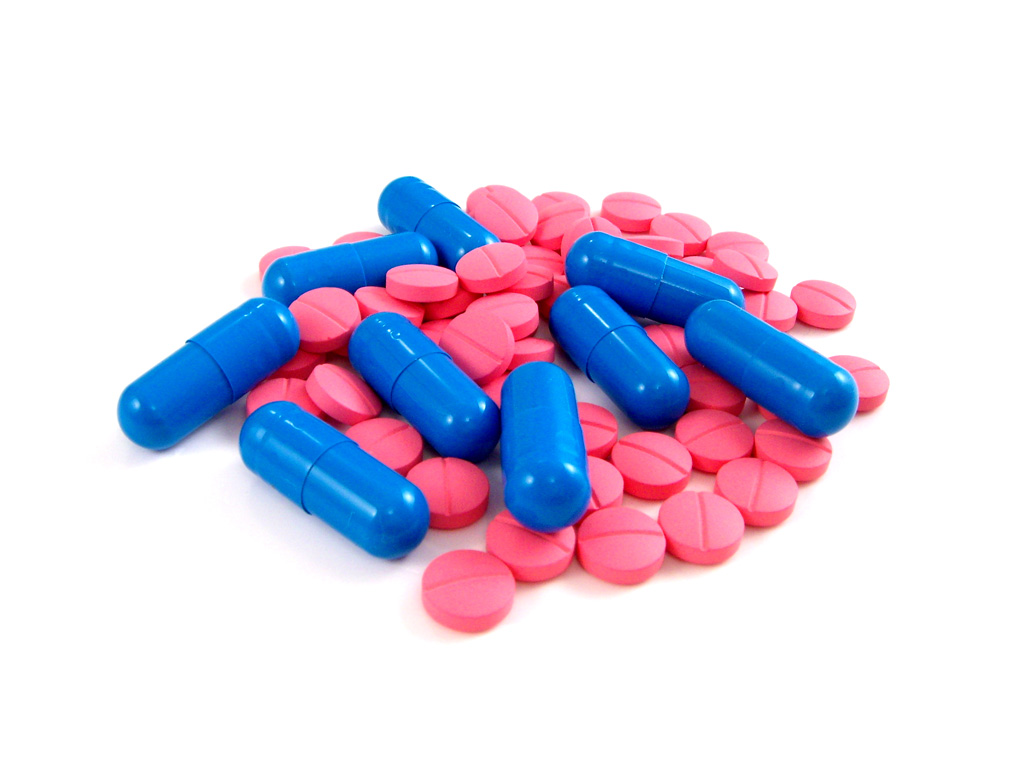
The doctors warned that the drug could potentially kill an individual after taking only two Zohydro capsules. A child, meanwhile, could suffer a fatal overdose from just one pill.
“In the midst of a severe drug addiction epidemic fueled by overprescribing of opioids, the very last thing the country needs is a new, dangerous, high-dose opioid,” the letter reads.
Speaking to Forbes, Andrew Kolodny, of the advocacy group Physicians for Responsible Opioid Prescribing, was even more direct: “It’s a whopping dose of hydrocodone packed in an easy-to-crush capsule. It will kill people as soon as it’s released.”
According to NBC News, Congressional representatives and attorney generals from 28 states have also called on the FDA to reconsider the drug’s approval.
Although Zohydro is comprised of the same ingredients found in Vicodin and OxyContin, but it’s not just the higher dose that has medical experts and lawmakers concerned. As RT reported in November, the FDA did not mandate Zohydro to follow the same abuse-deterrents that other drugs do. As a result, the drug will remain just as effective if crushed, snorted, or taken in a way other than originally intended. All this has opponents worried that Zohydro’s potential for abuse greatly exceeds that of other options on the market.
Still, some doctors believe the strong dosage would benefit a select group of patients. Dr. Zonfu Chen of the University Pittsburgh Medical Center East told NBC that Zoyhdro could be helpful to patients who cannot take pain medication outside of hydrocodone.
"The bottom line is no matter which narcotic you're talking about, if you don't use it right it can be abused,” Chen said. “It can be addictive. It all depends on how doctors monitor it. It could be lifesaving. But if used the wrong way, like any medication, it can cause trouble."
Forbes noted that Zohydro’s manufacturer, Zogenix, has also claimed the drug does not contain acetaminophen, which Vicodin does, and therefore is actually safer to use. Others say that difference is negligible, since there are similar medications already available.
The letter to the FDA also placed Zohydro in a larger context regarding drug use in the United States. It noted that 2012 data by the International Narcotics Control Board found Americans consume more than 99 percent of the world’s hydrocodone supply and 84 percent of the global stock of oxycodone.
According to the Centers for Disease Control and Prevention, overdose deaths in the US have skyrocketed since 1999, from roughly 4,000 to nearly 17,000 in 2010.
Although the FDA only reconsiders its rulings on rare occasions, Dr. Jeanmarie Perrone of the University of Pennsylvania School of Medicine told NBC it’s possible. "There is precedent for reversing,” she said. “I think it could be reevaluated.”
Although the opiate Zohydro was ultimately approved by the US Food and Drug administration, that endorsement went against the recommendation given by the agency’s own advisory panel. The panel voted 11 – 2 against approving the drug, but the FDA argued its availability is necessary to help patients unfazed by current medication.
The doctors warned that the drug could potentially kill an individual after taking only two Zohydro capsules. A child, meanwhile, could suffer a fatal overdose from just one pill.
“In the midst of a severe drug addiction epidemic fueled by overprescribing of opioids, the very last thing the country needs is a new, dangerous, high-dose opioid,” the letter reads.
Speaking to Forbes, Andrew Kolodny, of the advocacy group Physicians for Responsible Opioid Prescribing, was even more direct: “It’s a whopping dose of hydrocodone packed in an easy-to-crush capsule. It will kill people as soon as it’s released.”
According to NBC News, Congressional representatives and attorney generals from 28 states have also called on the FDA to reconsider the drug’s approval.
Although Zohydro is comprised of the same ingredients found in Vicodin and OxyContin, but it’s not just the higher dose that has medical experts and lawmakers concerned. As RT reported in November, the FDA did not mandate Zohydro to follow the same abuse-deterrents that other drugs do. As a result, the drug will remain just as effective if crushed, snorted, or taken in a way other than originally intended. All this has opponents worried that Zohydro’s potential for abuse greatly exceeds that of other options on the market.
Still, some doctors believe the strong dosage would benefit a select group of patients. Dr. Zonfu Chen of the University Pittsburgh Medical Center East told NBC that Zoyhdro could be helpful to patients who cannot take pain medication outside of hydrocodone.
"The bottom line is no matter which narcotic you're talking about, if you don't use it right it can be abused,” Chen said. “It can be addictive. It all depends on how doctors monitor it. It could be lifesaving. But if used the wrong way, like any medication, it can cause trouble."
Forbes noted that Zohydro’s manufacturer, Zogenix, has also claimed the drug does not contain acetaminophen, which Vicodin does, and therefore is actually safer to use. Others say that difference is negligible, since there are similar medications already available.
The letter to the FDA also placed Zohydro in a larger context regarding drug use in the United States. It noted that 2012 data by the International Narcotics Control Board found Americans consume more than 99 percent of the world’s hydrocodone supply and 84 percent of the global stock of oxycodone.
According to the Centers for Disease Control and Prevention, overdose deaths in the US have skyrocketed since 1999, from roughly 4,000 to nearly 17,000 in 2010.
Although the FDA only reconsiders its rulings on rare occasions, Dr. Jeanmarie Perrone of the University of Pennsylvania School of Medicine told NBC it’s possible. "There is precedent for reversing,” she said. “I think it could be reevaluated.”
Everyone In America Is Even More Broke Than You Think
The massive and growing gulf between rich and poor is one of the direst challenges facing the U.S. economy.
Highlighting this gap, more than half of U.S. wage earners made less than $30,000 last year, according to an analysis released by the Social Security Administration on Tuesday. That's not far above the $27,010 that marked the federal poverty line for a family of five in 2012.
 We've created this infographic to help visualize the skewed income distribution in the country.
Where do you stack up?
-If you make more than $10,000, you earn more than 24.2% of Americans, or 37 million people.
-If you make more than $15,000 (roughly the annual salary of a minimum-wage employee working 40 hours per week), you earn more than 32.2% of Americans.
-If you make more than $30,000, you earn more than 53.2% of Americans.
-If you make more than $50,000, you earn more than 73.4% of Americans.
-If you make more than $100,000, you earn more than 92.6% of Americans.
-You are officially in the top 1% of American wage earners if you earn more than $250,000.
-The 894 people that earn more than $20 million make more than 99.99989% of Americans, and are compensated a cumulative $37,009,979,568 per year.
*Based on the 153.6 million American wage-earners, as defined by the Social Security Administration.
Highlighting this gap, more than half of U.S. wage earners made less than $30,000 last year, according to an analysis released by the Social Security Administration on Tuesday. That's not far above the $27,010 that marked the federal poverty line for a family of five in 2012.
Where do you stack up?
-If you make more than $10,000, you earn more than 24.2% of Americans, or 37 million people.
-If you make more than $15,000 (roughly the annual salary of a minimum-wage employee working 40 hours per week), you earn more than 32.2% of Americans.
-If you make more than $30,000, you earn more than 53.2% of Americans.
-If you make more than $50,000, you earn more than 73.4% of Americans.
-If you make more than $100,000, you earn more than 92.6% of Americans.
-You are officially in the top 1% of American wage earners if you earn more than $250,000.
-The 894 people that earn more than $20 million make more than 99.99989% of Americans, and are compensated a cumulative $37,009,979,568 per year.
*Based on the 153.6 million American wage-earners, as defined by the Social Security Administration.
Subscribe to:
Posts (Atom)